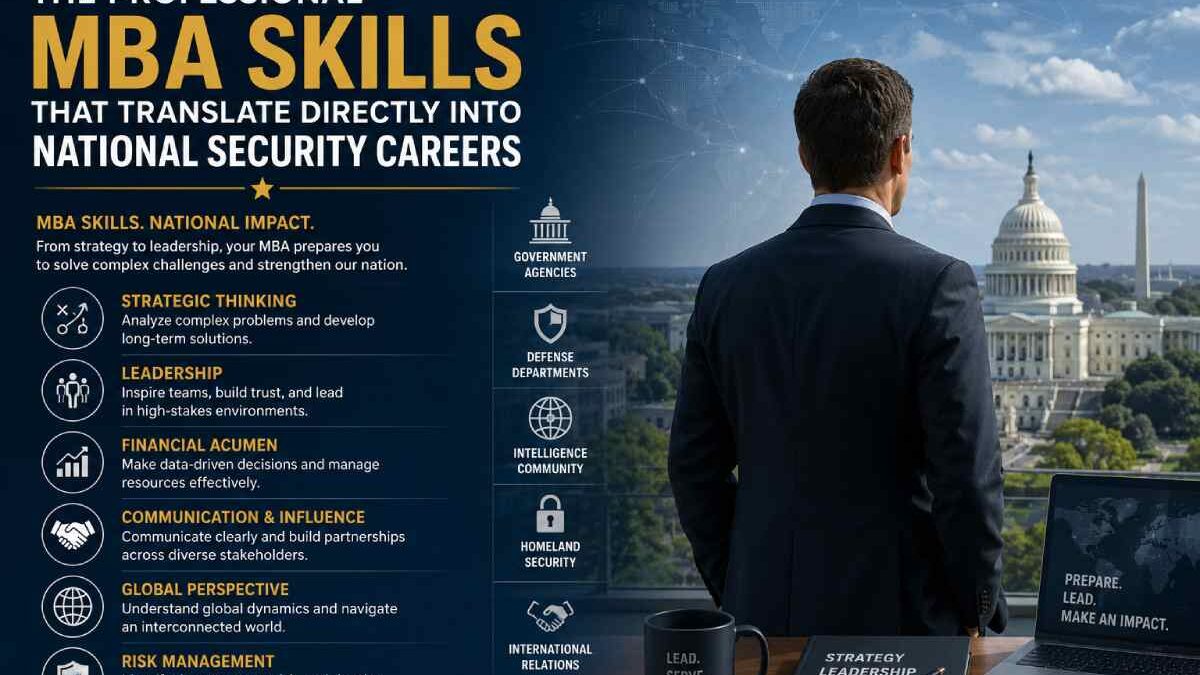
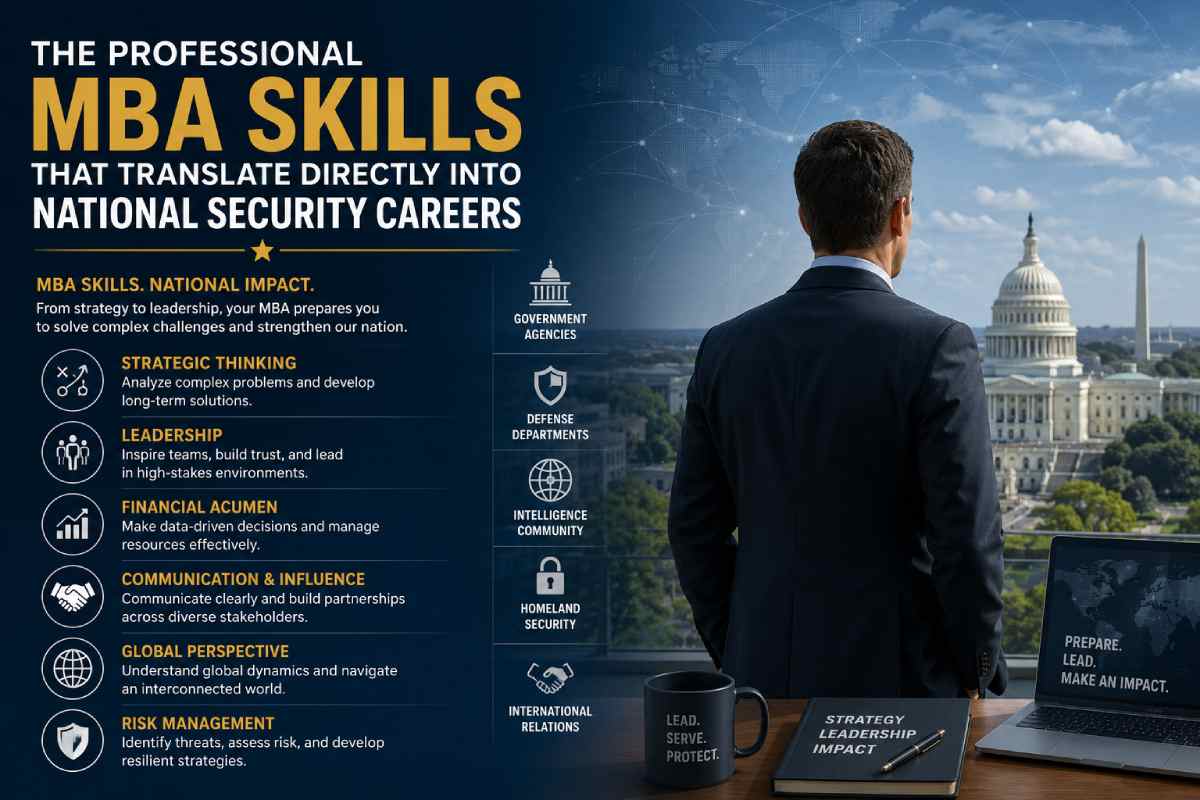
Master of Business Administration (MBA) graduates boast the skills, knowledge, and experience to catapult their careers and become great leaders. They often work at the highest levels of business, but their skills translate into other fields, including national security. After all, national security affects everyone in the country, and such agencies employ the best and brightest individuals.
There is more crossover between business and national security agencies than many people assume. This comes down to the foundational skills that MBA programs provide. Follow along as we highlight the professional MBA skills that translate directly into national security careers.
Table of Contents
Data Analytics
Data analytics skills are equally important in business and national security alike. Professional MBA students learn to blend business skills with data analytics theory to inform decisions. These skills translate into national security careers where people use data to identify threats and examine intelligence.
Whether you’re a counterintelligence officer or a supply chain manager, you must constantly sort through valuable data. It’s easy to assume that artificial intelligence has limited the need for data analytics skills. However, that couldn’t be further from the truth, especially in counterintelligence and other national security fields.
Sure, business and national security professionals use AI and other tools, but fact-checking and personal insight are still valuable. The ability to extract key insights from data to forecast and respond to trends, emergencies, and threats is more important than ever.
Concise Communication
Big businesses and national intelligence agencies consist of many moving parts, all of which are important. Whether you work at a huge corporation or the CIA, you must learn to share information with other departments as effectively as possible. Concise communication skills are ingrained in Professional MBA graduates, who must summarize data quickly and in a palatable way.
Similarly, national security professionals must concisely summarize information to debrief other departments. This is essential in national security, where brevity is as important as the information being shared. Leaders can’t sort through hours of paperwork and intelligence reports, so that responsibility falls on agents.
The same applies to the business world, where executives rely on their teams to articulate vital information. Delivering key insights and data while using minimal words requires experience, but MBA programs lay the foundation for this skill.
Risk Mitigation
Many people pursue MBAs to work as supervisors, advisors, and managers in business. Naturally, business leaders and supervisors assume a lot of responsibility for what goes on in the organization. Risk is a big part of this responsibility, and that’s why Professional MBA students learn so much about risk assessment and mitigation.
However, risk assessment is an even bigger part of working in national security. After all, national security professionals must identify risks that often affect a large portion of the population. That includes terrorism threats, cybercrimes, espionage, and military aggression.
While national security and business professionals handle different risks, the skills remain the same. MBA programs teach students to track and model data to forecast trends, identify anomalies, and gather important insights. Each of these factors is important in national security, albeit on a bigger scale.
Collaboration
Collaboration is essential when running a business or working alongside others to protect the country. Corporations and national security agencies are similar in that they consist of many departments. The people in these departments must collaborate to support the larger organization as a whole.
National security is unique in that entirely separate agencies must often collaborate. Naturally, cross-agency collaboration only works when everyone prioritizes a shared goal. This requires people to set their egos aside, identify common goals, and combine resources.
The same principles apply to business, albeit with lower stakes. Professional MBA students learn to collaborate early on when paired with peers in immersive business simulations and exercises.
Crisis Intervention
No business or government agency is immune to crises. How a business or an agency responds to such crises will lay the foundation for what comes next. Businesses encounter crises due to market crashes, reputational damage, lawsuits, and beyond.
Government agencies must manage serious national security crises and natural disasters, which means the stakes are always high. While national security crises are more serious than business crises, the necessary response is similar. Businesses and national security agencies elect cross-functional teams to address and respond to such crises.
Crisis response teams must utilize all their skills, from collaboration and communication to data analytics. Naturally, having an MBA makes this slightly easier, given the advanced preparation and collaborative curriculum.
Ethics
Any MBA graduate or national security professional who doesn’t prioritize ethics is doing the world a disservice. We can all find examples of unethical behavior in business and intelligence, but today’s world prioritizes accountability more than ever. Ethics benefits not only business and national security professionals but also the general public.
Business and national security professionals alike handle sensitive information. In business, this includes customers’ financial information and personal data. National security professionals also handle sensitive information gathered through intelligence operations.
A strong ethical foundation teaches these people to use this information correctly without violating anyone’s privacy. Inter-office transparency is another key part of business ethics that translates into national security.
Leadership
MBA degrees appeal to people who want to fast-track their careers and become leaders. These leadership skills come from the curriculum and collaborating with peers. Leadership skills are just as important in business as they are in national security and intelligence.
The conversations in corporate offices differ from those in intelligence offices, but the same principles apply. Businesses and intelligence agencies rely on leaders who can see the big picture and articulate their vision. They must also promote healthy conversation and collaboration while remaining decisive and positive.
Professional MBAs Offer Limitless Potential
Sure, most Professional MBA graduates pursue traditional business careers. However, the skills that Professional MBA programs provide don’t limit anyone to one field. Having such an advanced career can fast-track your business career just as it can help you land a coveted national security role.
That’s especially true if your resume shows that you’ve applied your Professional MBA skills in the field. Collaboration, data analytics, ethics, leadership, and risk management skills are equally important in business and national security. The beauty of Professional MBA programs is that they prepare you for any field that calls to you.
Also Read: The Technology Literacy Requirements for Modern Public Administration Careers