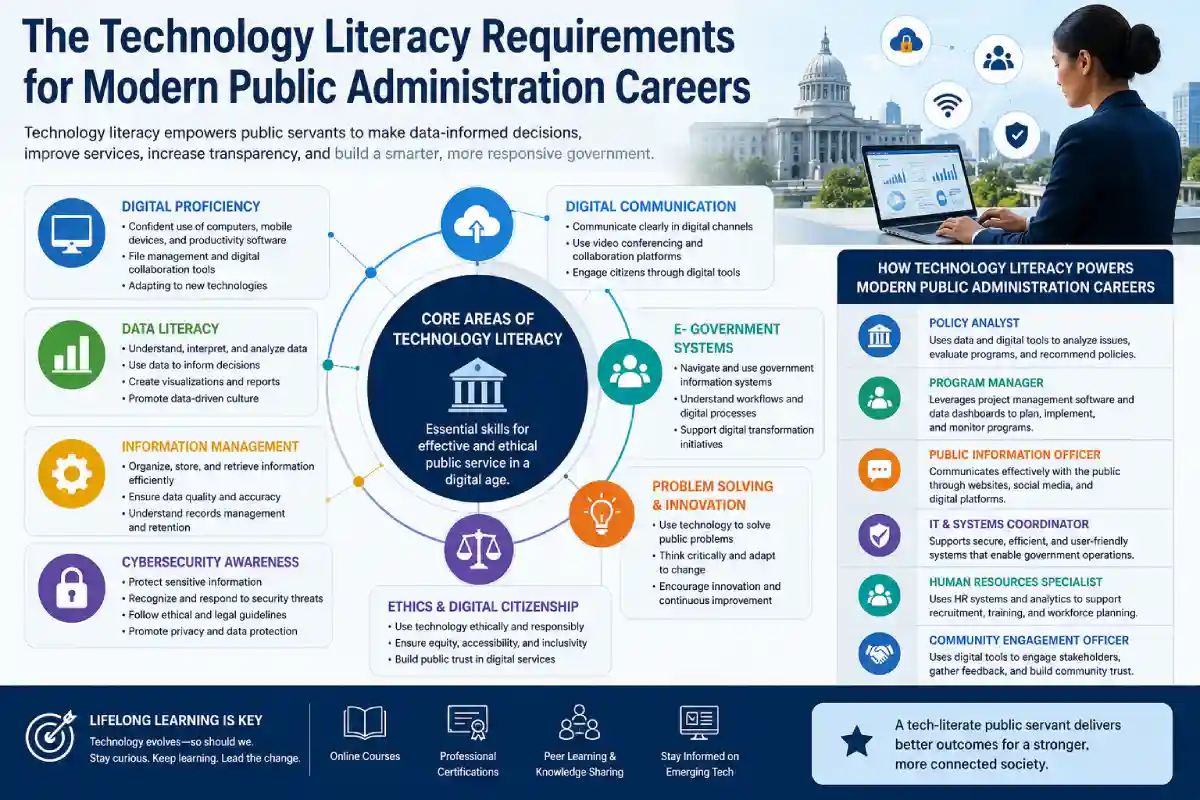
Information technology used to be a small niche, but those days are long over. Nearly all businesses rely so heavily on technology that they must look for candidates with IT skills, and public administration offices — which handle and process tons of data and sensitive information each day — are no exception.
Public administration is in the middle of a technology-driven transformation that is fundamentally changing what competency looks like for professionals working in government, nonprofit, and public sector leadership roles. The days when an administrator could delegate all technology decisions to an IT department and focus purely on policy, finance, and operations are over.
What follows is an examination of the specific technology competencies that are reshaping public administration careers and what that means for professionals building or advancing careers in government and public service.
Table of Contents
Why Technology Literacy Has Become a Public Administration Requirement
The delivery of public services — benefits administration, permit processing, tax collection, public health surveillance, emergency management, and citizen communications — has migrated substantially to digital platforms over the past decade. Public administrators are now routinely making decisions about technology systems, data management, and digital service delivery that directly affect the quality of services millions of people depend on.
Public administration often involves handling important and sensitive information, and protecting this data is paramount. Government agencies are among the most heavily targeted organizations for cyberattack, holding sensitive citizen data, critical infrastructure controls, and systems whose disruption has direct public safety implications.
Ransomware attacks on municipal governments, data breaches at federal agencies, and intrusions into public health systems have all demonstrated that cybersecurity is not an IT department problem but a leadership problem. Data leaks and cyberattacks compromise sensitive data and make the public distrust those who should have protected it.
Public sector organizations collect and manage enormous volumes of citizen data, and the legal, ethical, and operational implications of how that data is stored, accessed, shared, and protected fall squarely within the domain of administrative leadership. Administrators who understand data governance — including privacy law requirements, data sharing agreements, retention policies, and the risks of inadequate data security — are better positioned to protect both the people their agencies serve and the organizations they lead.
The IT Skills That Matter Most in Public Administration Contexts
Cybersecurity Fundamentals
Administrators do not need to be security engineers, but they need to understand the threat landscape well enough to evaluate security recommendations, allocate resources appropriately, and recognize the organizational behaviors that create vulnerability. This includes familiarity with common attack vectors, understanding of security frameworks like NIST and FedRAMP, and the ability to interpret security assessments and incident reports.
Sometimes, public administration offices hire third-party cybersecurity firms to train the staff. Cybersecurity analysts and engineers will train the staff to recognize phishing scams and respond to data breaches, but that’s not always the case, and many public administration offices look for candidates who already have cybersecurity skills and credentials.
The rise of artificial intelligence has created even greater cybersecurity risks, and public administration offices must take this into account. Public administrators with cybersecurity fluency are better positioned to build the security-aware organizational cultures that technical controls alone cannot produce and to advocate for security investments in budget processes where competing priorities are always present.
They can also respond effectively when incidents occur — making decisions about disclosure, remediation, and communication that have both technical and reputational dimensions requiring leadership judgment.
Data Analysis and Management
Public administration offices handle and run many public programs, and how they run such programs and how much money they allocate to them largely depends on data. Data management is easily one of the most important requirements of technological literacy for public administration professionals.
The evidence-based policy and program evaluation demands of modern public administration require administrators who can work with data — interpreting performance metrics, evaluating program outcomes, identifying patterns in service delivery data, and using analytical tools to support decision-making. This is not the deep statistical expertise of a data scientist but the practical analytical literacy of a leader who can ask the right questions of data and evaluate the answers they receive.
Data largely influences the policies and programs that public administrators implement, drawing on demographic, social, financial, and public health data from many sources. Public administration professionals must be able to process and organize this data to ensure it gets used properly.
Quality assurance is a big part of this as well, as administrators must sort through and verify such data. Verifying all fields and ensuring data is consistent across all agencies has become essential.
Proficiency with data visualization tools, basic understanding of database concepts, familiarity with government data standards and open data requirements, and the ability to evaluate the quality and limitations of data sources are all competencies that appear consistently in public sector job descriptions.
Professionals who bring these skills alongside policy and management expertise occupy a distinctly valuable position, and guidance on the best IT skills for your resume consistently emphasizes this combination.
Digital Project Management
Government agencies are continuously implementing new technology systems — ERP implementations, digital service redesigns, database migrations, and cybersecurity infrastructure upgrades. The administrators who oversee these projects need enough technology literacy to evaluate vendor proposals, manage technical project teams, monitor implementation progress, and identify when a project is veering off course.
Many of the most costly public sector technology failures have been leadership failures rather than technical ones, driven by administrators who could not effectively oversee the technical work they were responsible for. The lesson has been expensive and recurring.
Public sector technology procurement is governed by complex regulatory frameworks — including federal acquisition regulations, state procurement statutes, and mandatory security review processes — that require administrators to understand both the technical and legal dimensions of government contracting.
Administrators who understand technology well enough to write effective requirements, evaluate bids, and manage vendor relationships produce better procurement outcomes than those who delegate these decisions entirely to technical staff.
How the MPA Credential Positions Professionals for Technology-Intensive Public Sector Roles
The Master of Public Administration develops the policy analysis, organizational management, public finance, and program evaluation competencies that form the administrative foundation of government careers. It is the credential most consistently associated with advancement into senior leadership roles in federal, state, and local government, as well as in nonprofit and international development organizations.
Digital literacy is just as valuable as an MPA degree, as both can differentiate candidates from others who are unwilling to go above and beyond. The strongest professional profile combines both rather than choosing between them.
The analytical, management, and policy competencies developed in MPA programs create a professional foundation that makes technology literacy more valuable rather than less. The administrators most capable of deploying technology effectively in public sector contexts are those who understand both the technical capabilities and the policy, organizational, and equity dimensions of how those capabilities are applied.
Technology literacy without policy and management grounding produces technical solutions that fail to navigate the institutional context of government. Policy and management expertise without technology literacy produces leaders who cannot effectively oversee the digital infrastructure their organizations depend on. The MPA career paths that reward technology fluency most consistently are the ones at the intersection of policy and digital infrastructure.
Federal agency IT leadership, state and municipal chief information officer positions, government digital transformation program management, public health informatics, emergency management technology coordination, and cybersecurity policy roles all represent career pathways where the combination of public administration expertise and technology literacy is the defining professional profile. Demand for qualified candidates substantially exceeds the current supply across all of these roles.
Conclusion
Technology literacy is no longer a supplementary skill for public administrators who happen to work near IT systems. It is a core professional competency that is reshaping what effective public administration looks like and what career advancement in the public sector requires.
If the last several years of technology have taught us anything, it’s that technology moves fast and waits for no one. Whether it be AI automation tools or new cybersecurity programs, public administration professionals must keep up with these innovations and familiarize themselves with them.
The better an office manages data and protects against cybersecurity risks, the more easily it can serve the public. Communities should be able to trust that their administrators handle their sensitive data as well as possible and have their best interests in mind.
For professionals building or advancing public administration careers, the question is not whether to develop technology literacy but which specific competencies to prioritize given their career trajectory and the specific technology challenges of the public sector context they work in.
The combination of strong public administration credentials and deliberately developed IT competency is the professional profile that the current public sector hiring environment is most consistently rewarding.