For decades, a nurse’s career trajectory typically followed a predictable, vertical path: bedside staff nurse, charge nurse, nurse manager, and perhaps nursing administration. While noble and essential, these roles were physically demanding, geographically tethered, and often limited by the finite number of hours one could spend on their feet.
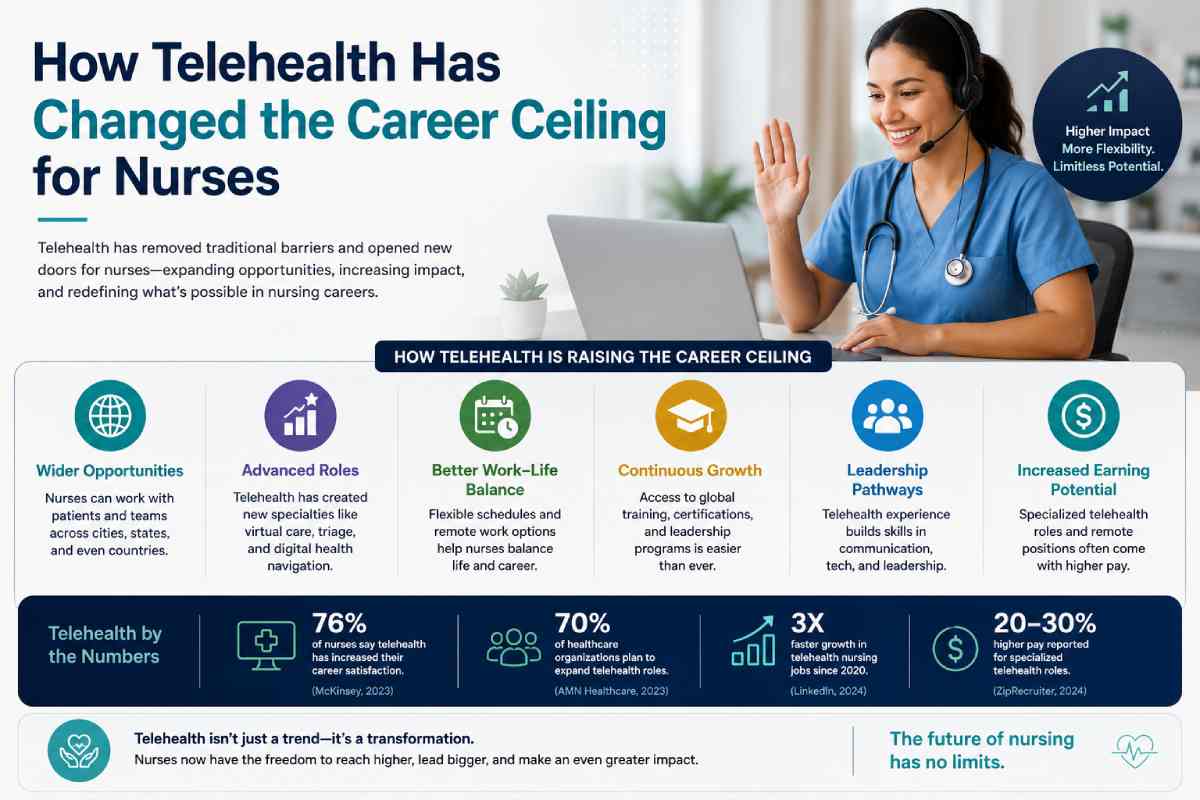
Today, however, the digital revolution—accelerated by the COVID-19 pandemic—has dismantled these traditional barriers. Telehealth has not merely added a technological layer to nursing, it has fundamentally shattered the “career ceiling,” and now offers a new blueprint for professional growth, longevity, and autonomy.
The following are some ways in which telehealth technology has changed career opportunities for nurses.
Table of Contents
Breaking the Geographic and Physical Tether
Historically, nurses who suffered from chronic injuries, those living in rural areas, or those needing to care for family members at home faced an abrupt end to their clinical careers.
Telehealth has transformed these limitations into opportunities. A nurse in a rural town in Montana can now provide expert triage or psychiatric support to a patient in a bustling Manhattan emergency room. This geographic fluidity means that a nurse’s career no longer depends on their proximity to a major medical hub.
Furthermore, telehealth allows for “career longevity.” Nurses who were previously forced into early retirement due to the grueling physical toll of lifting patients and working 12-hour shifts now have a viable professional alternative.
By transitioning to virtual care, these veteran nurses keep their decades of expertise in the workforce, moving from bedside care to high-level clinical consultation, remote chronic disease management, and tele-triage.
Diversification of Skill Sets
Before the rise of tele-nursing, a nurse’s skill set was primarily clinical and interpersonal. Telehealth, however, demands a unique hybrid of nursing expertise and digital literacy. Nurses are now becoming proficient in data analytics, remote patient monitoring (RPM) technology, and the nuances of virtual communication.
This evolution has paved the way for nurses to pivot into roles that were once reserved for IT specialists or administrative consultants. Nurses are now working as “Telehealth Implementation Specialists,” “Clinical Informatics Nurses,” and “Virtual Care Strategy Consultants.”
By mastering the digital tools that power healthcare, nurses have moved out of the patient care pipeline and into the C-suite and product-development rooms of healthcare technology companies. They are the ones informing how health apps are designed and how virtual interfaces can be made more user-friendly for geriatric populations.
This shift represents a transition from being a recipient of hospital workflows to being a designer of them.
Autonomy and the Entrepreneurial Pivot
Perhaps the most exciting shift is the rise of the nurse-entrepreneur. Telehealth platforms have lowered the barrier to entry for private practice. A psychiatric nurse practitioner or a specialized nurse educator no longer needs to secure expensive office space or navigate complex hospital billing bureaucracies. Now they can launch a digital practice with a secure video platform and a laptop.
This autonomy allows nurses to specialize in niche areas—such as telehealth lactation consulting, virtual diabetes management, or digital health coaching—and build brands that transcend the institutional loyalty typically required by hospital employment. The career “ceiling” has been replaced by a “landscape,” where nurses can choose to be W-2 employees for massive virtual health networks, 1099 contractors for boutique tele-health startups, or business owners in their own right as something like a Family Nurse Practitioner.
Navigating New Challenges
While the career ceiling has been raised, it is important to acknowledge the new hurdles. Digital burnout is a real phenomenon; staring at a screen for eight hours while managing complex cases requires a different kind of stamina than physical nursing. Furthermore, the loss of tactile patient interaction can be difficult for those who went into nursing for the human touch.
However, the industry is responding. Virtual care models are increasingly incorporating “hybrid” approaches, where nurses spend part of their time in clinics and part in virtual environments, providing a balanced, sustainable career model that was previously unimaginable.
The Future of the Nursing Profession
Telehealth has effectively turned the nursing profession into a dynamic, tech-forward path with nursing career advancement opportunities that offers infinite scalability.
By de-linking nursing from physical endurance, the industry has opened the door for a more diverse, experienced, and highly skilled workforce. We are moving toward a future where a nurse’s influence is measured not by how many patients they see in a shift, but by the scale of the digital systems they oversee and the quality of care they deliver across borders.
The “ceiling” that once capped a nurse’s potential to the physical room they worked in has vanished. In its place is a wide-open digital frontier, inviting nurses to redefine what it means to be a healer in the 21st century. Whether as technological innovators, virtual consultants, or remote clinicians, nurses are no longer just supporting the healthcare system—they are architecting its future.
Also Read: FindRemind Review: What Is It and Who Is It Actually For?