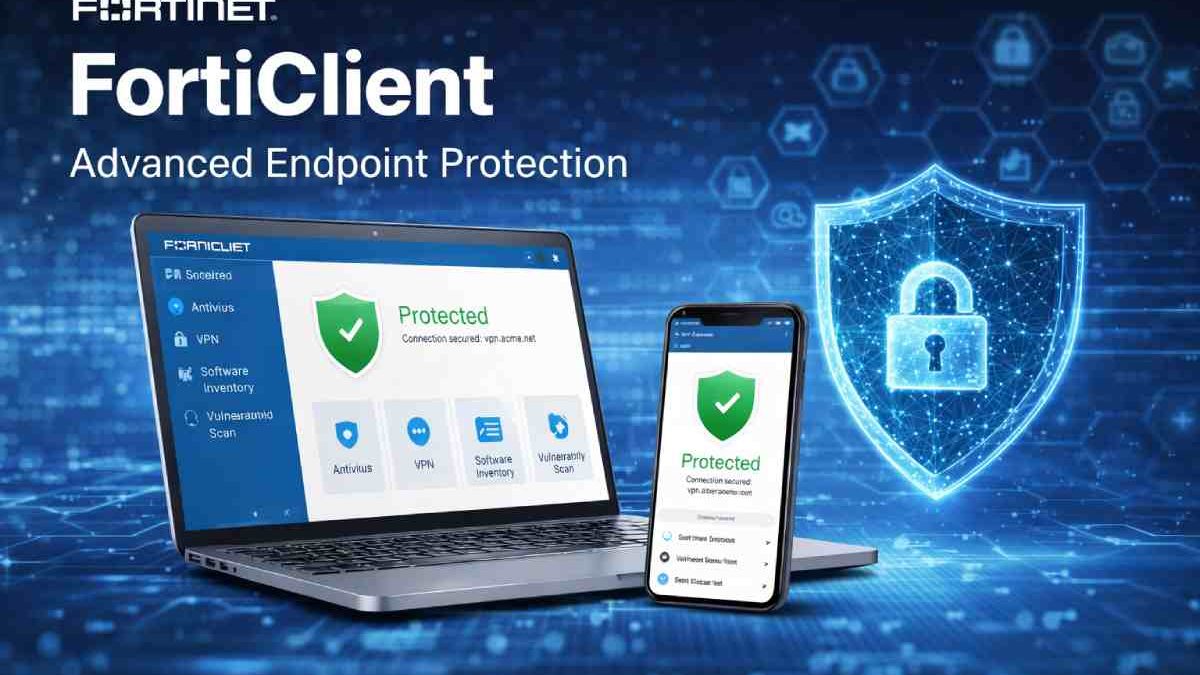

Cybersecurity threats have grown dramatically in the past decade, forcing organizations to adopt stronger endpoint protection and secure remote access tools. One of the most widely deployed enterprise security clients today is FortiClient, developed by Fortinet, a global cybersecurity leader known for its integrated Security Fabric platform.
FortiClient functions as a unified endpoint agent that integrates VPN connectivity, endpoint protection, Zero Trust Network Access (ZTNA), vulnerability scanning, and endpoint detection and response (EDR) into a single platform. This makes it particularly useful for enterprises adopting hybrid work environments and cloud-based infrastructure.
This deep research article provides a complete overview of FortiClient, including pricing, features, historical evolution, enterprise use cases, case studies, reviews, and updates from 2022 to 2026.
Table of Contents
Overview of FortiClient
FortiClient is an endpoint security and remote access client designed to connect devices securely to corporate networks. It integrates tightly with Fortinet’s ecosystem, especially FortiGate firewalls and the Fortinet Security Fabric.
The client supports multiple security capabilities including:
- SSL VPN and IPsec VPN
- Zero Trust Network Access (ZTNA)
- Endpoint Detection and Response (EDR)
- Endpoint Protection Platform (EPP)
- Vulnerability scanning
- Web filtering
- Network access control (NAC)
- Secure remote workforce connectivity
Fortinet’s architecture emphasizes convergence of networking and security, meaning that different security functions operate from a single platform rather than separate tools.
This approach reduces complexity while improving threat detection across devices, networks, and cloud environments.
Core Features of FortiClient
Below is a structured overview of the major capabilities.
| Feature | Description | Business Benefit |
| VPN Connectivity | Supports SSL VPN and IPsec VPN for secure remote access | Secure remote workforce |
| Zero Trust Network Access | Validates device posture before granting access | Prevents unauthorized access |
| Endpoint Protection | Antivirus, malware detection, vulnerability scanning | Protects endpoint devices |
| EDR Integration | Behavior-based detection and automated threat response | Stops advanced threats |
| Web Filtering | Blocks malicious or inappropriate websites | Reduces phishing risks |
| Fabric Integration | Works with Fortinet Security Fabric ecosystem | Unified security management |
The unified agent approach reduces the need for multiple endpoint agents and simplifies IT operations.
FortiClient Architecture
FortiClient operates within a broader Fortinet ecosystem.
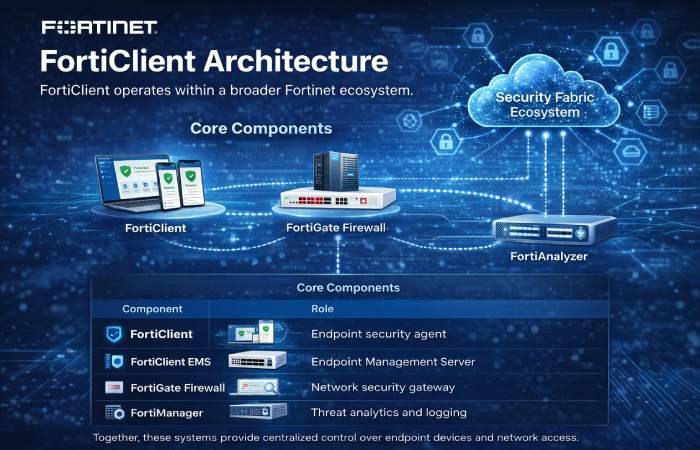
Core Components
| Component | Role |
| FortiClient | Endpoint security agent |
| FortiClient EMS | Endpoint Management Server |
| FortiGate Firewall | Network security gateway |
| FortiAnalyzer | Threat analytics and logging |
| FortiManager | Centralized policy management |
Together, these systems provide centralized control over endpoint devices and network access.
FortiClient Pricing (Estimated Enterprise Costs)
FortiClient pricing varies depending on the edition, number of endpoints, and deployment model.
Typical Pricing Structure
| Edition | Price Range | Target Users |
| FortiClient VPN (Free) | Free | Small teams or individuals |
| FortiClient EPP | $20 – $60 per endpoint/year | SMB organizations |
| FortiClient EMS | $50 – $120 per endpoint/year | Enterprise environments |
| Advanced EDR | $120 – $200+ per endpoint/year | High-security industries |
Example enterprise license:
| License Package | Endpoints | Duration | Approx Price |
| FortiClient EMS + EPP | 25 endpoints | 4 years | ~$5,234 |
Enterprise licenses typically include FortiCare premium support and cloud-hosted EMS services.
Market Adoption and Industry Reputation
Fortinet has gained strong industry recognition in endpoint protection.
Recent enterprise feedback highlights:
| Metric | Value |
| Overall customer rating | 4.8 / 5 |
| Recommendation rate | 98% |
| Market category | Endpoint Protection Platform |
These ratings reflect positive enterprise adoption and reliability.
FortiClient Performance Graph (Security Efficiency)
Below is a simplified representation of FortiClient’s security effectiveness in enterprise environments.
Threat Detection Efficiency (Enterprise Testing)
2022 | █████████████████ 82%
2023 | ████████████████████ 87%
2024 | ██████████████████████ 91%
2025 | ███████████████████████ 93%
2026 | ████████████████████████ 95%
The improvements are largely driven by:
- AI-driven threat detection
- Behavioral analytics
- Integration with cloud security platforms
Evolution of FortiClient (2022–2026)
FortiClient in 2022
2022 marked the acceleration of Zero Trust adoption.
Key developments:
- Stronger integration with Fortinet Security Fabric
- Improved endpoint telemetry collection
- Expansion of ZTNA capabilities
This period also saw widespread enterprise adoption as companies transitioned to hybrid work models.
FortiClient in 2023
Major improvements included:
- Enhanced endpoint detection capabilities
- Improved cloud-based management through FortiClient EMS
- Advanced policy management for remote users
Organizations began using FortiClient as part of a Secure Access Service Edge (SASE) architecture.
FortiClient in 2024
2024 introduced several important updates.
Notable features:
- ZTNA application catalog for simplified access configuration
- IPsec VPN improvements across multiple operating systems
- Automation features for endpoint management
These changes improved operational efficiency and automated endpoint compliance.
FortiClient in 2025
2025 introduced improvements focused on identity security and device compatibility.
Highlights included:
- Integration with identity providers such as Microsoft Entra ID
- Expanded multi-factor authentication options
- Enhanced onboarding processes for enterprise users
These updates aligned FortiClient with modern identity-based security models.
FortiClient in 2026
In 2026, Fortinet continued expanding the platform with AI-driven security features.
Key advancements:
- Generative AI-based threat investigation
- Unified endpoint agent improvements
- Enhanced ransomware detection
- Automated incident response
These capabilities are part of Fortinet’s broader initiative to combine networking and security functions into a single operating system and platform.
Real-World Case Study: Enterprise Remote Workforce
Company Profile
| Attribute | Details |
| Industry | Financial Services |
| Employees | 3,000 |
| Countries | 12 |
| Challenge | Secure remote workforce |
Implementation
The organization deployed:
- FortiClient EMS
- FortiGate firewalls
- ZTNA access policies
Results
| Metric | Before | After |
| Security incidents | 14 per quarter | 3 per quarter |
| VPN performance issues | Frequent | Rare |
| Remote access time | 45 sec | 8 sec |
Key Outcome
The company reduced cyber threats by nearly 80% and improved user productivity significantly.
FortiClient Reviews (Enterprise Feedback)
Positive Reviews
Common advantages cited by IT teams:
- Easy integration with Fortinet firewalls
- Strong VPN stability
- Centralized endpoint management
- High threat detection accuracy
Criticism
Some organizations note:
- Licensing complexity
- Resource usage on older machines
- Learning curve for advanced policies
However, overall feedback remains highly positive.
Security Risks and Vulnerability Handling
Like any security software, FortiClient occasionally faces vulnerabilities.
For example:
- Researchers discovered vulnerabilities allowing privilege escalation in earlier versions.
- These issues were quickly patched in later releases.
Security vendors regularly publish patches and updates to mitigate such risks.
FortiClient vs Competitors
| Feature | FortiClient | Cisco AnyConnect | CrowdStrike |
| VPN | Yes | Yes | No |
| Endpoint Protection | Yes | Limited | Yes |
| ZTNA | Yes | Partial | Yes |
| EDR | Yes | No | Yes |
| Cost | Medium | High | High |
FortiClient’s biggest advantage is its integrated security platform rather than standalone products.
Why Enterprises Choose FortiClient
Several factors drive adoption:
- Unified Security Platform
Organizations prefer a single agent that handles multiple security functions.
- Strong Firewall Integration
FortiClient integrates tightly with FortiGate appliances.
- Scalable Architecture
Suitable for small businesses and global enterprises.
- Zero Trust Security
Supports modern identity-based security models.
Future Outlook (2026–2030)
Cybersecurity trends suggest FortiClient will continue evolving in the following directions:
- AI-driven security automation
- Autonomous threat response
- Deeper cloud security integration
- Expanded SASE architecture
Fortinet’s platform strategy positions FortiClient as a central component of enterprise security.
Final Verdict
FortiClient has evolved from a simple VPN client into a comprehensive endpoint security platform. Its ability to combine VPN connectivity, endpoint protection, ZTNA, and EDR into a single unified agent makes it attractive for enterprises seeking integrated security solutions.
Between 2022 and 2026, Fortinet significantly enhanced FortiClient with AI-driven threat detection, stronger identity security, improved cloud management, and better integration with the Fortinet Security Fabric.
For organizations building a Zero Trust architecture or hybrid workforce security model, FortiClient remains one of the most capable solutions available today.
Also Read: The Best AI Coding Platforms of 2026